Amundsen Lab Members


Amundsen Lab Members
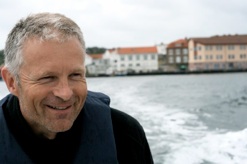
Trond has worked on a broad range of issues related to sexual selection, sex roles and parental care, using various bird and fish species as model organisms. He currently is particularly interested in the dynamics of animal sex roles, and «the other side» of sexual selection - why in many species females and not only males are beautifully ornamented. He currently studies these issues in two-spotted gobies, and in coral reef fishes. Trond did his PhD at the University of Oslo, Norway.
Elisabet Forsgren (researcher, Norwegian Institute for Nature Research NINA)
Elisabet is a fish behavioural ecologist with a focus on issues related to the evolution of reproductive behaviours, and a current particular emphasis on sex role dynamics. She previously worked mostly with sand gobies, but currently has uses two-spotted gobies as her main model species. Elisabet works at NINA in Trondheim, and is also involved in work on salmonids, and on management-related marine research and development. Elisabet did her PhD at Uppsala University, Sweden.
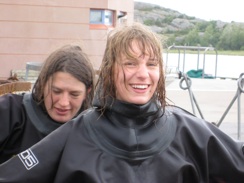
Lise studies effects of social environment on female mate sampling, and is about to initiate work on how environmental degradation affects the abundance and behaviour of two-spotted gobies. Such degradation is a major concern in Scandinavian coastal management, as the sugar kelp forests along rocky shores have suffered sever declines. Lise did her MSc at NTNU, Trondheim, Norway
Sebastian Wacker (PhD student)
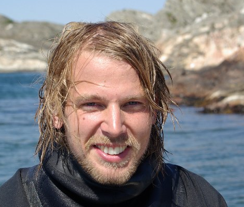
Sebastian works on the importance of male size in male-male competition, and the effects of social environment on genetic mating systems. He is also interested in linking fish personalities to reproductive behaviour and success. Sebastian did his MSc at Westfälische Wilhelms-Universität Münster, Germany, in collaboration with our team at NTNU.
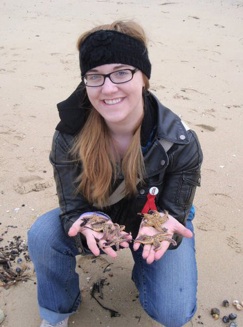
Elizabet has her MSc from the University of Sheffield, based on studies of sexual selection for body size in Drosophila fruitflies, and on effects of temperature on the ‘body build’ of fruitflies and ants. She currently works as a volunteer in our lab.